Flat email and SMS revenue
What changes in the first ninety days
Flows rebuilt, deliverability fixed, segments live. Maestra Platform is the all-in-one retention marketing platform for ecommerce brands, and your forward-deployed marketer sets the order.
Brands running on Maestra






The problem
Customers buy once and never come back
Acquisition is working, but retention isn't. Without flows that recognize a repeat customer, cross-sell them, or catch them before they churn, every new buyer is a one-time transaction instead of the start of a relationship.
What we hear from brands
High churn rate as customers typically make one-time purchases rather than repeat purchases, says a two-person marketing team at a home goods and drinkware brand.
Low repeat purchase and retention on one-time device sales, with an underperforming loyalty program and low subscription uptake, reports a wellness-device brand.
High volume of one-time customers, struggling to convert prospects to repeat buyers, notes a multi-brand toy company.
The new way
Segmentation that works without stacking exclusions
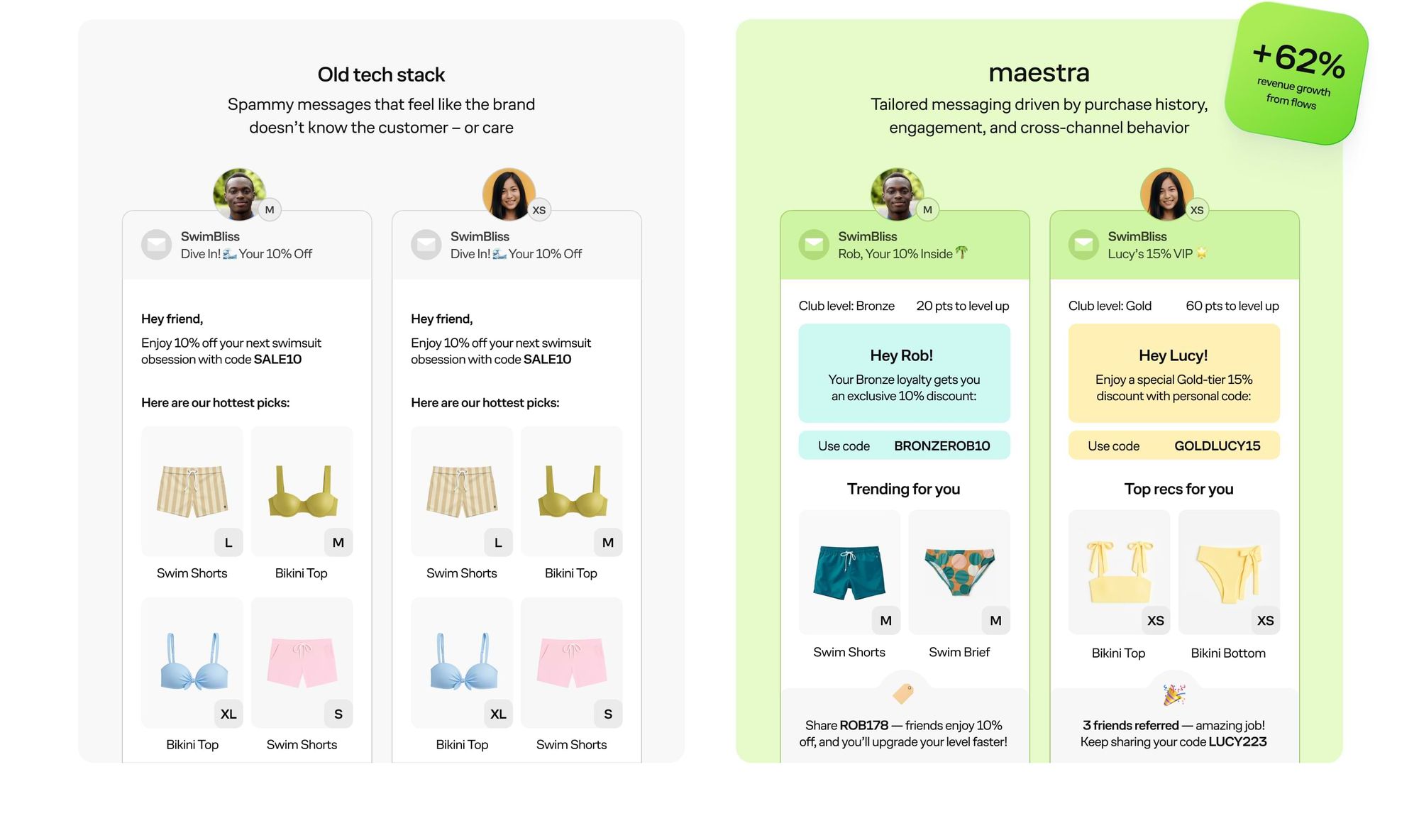
Instead of layering workarounds onto unreliable filters, Maestra's segmentation lets marketers build the audience they actually mean. Within a few months of switching, Blue Q's program had grown from a weekly blast plus two flows into coverage of the whole customer lifecycle.
Outcomes brands report
Customer proof
D. Steimatzky calls the revenue share the outcome that mattered

The measure the team cares about is not open rate but how much of the company's revenue direct communications carry. Approaching thirty percent changed what the channel is for.
29.4%
revenue share from direct communications
“This revenue share is an excellent outcome for us. We’ve already been able to significantly enhance our communications and identify new growth opportunities.”
How it works
Your old stack is the safety net
Keep it running
Nothing is switched off at the start. Both setups exist side by side while the new one is proven.
Compare before you commit
You see the rebuilt flows and segments against the ones you know before anything is pointed at customers.
Turn it off on your terms
The old contracts end when you say so, not because the migration forced the date.
The platform
Reporting that comes from the same place as the sending
Because campaigns, site behavior, and orders live in one system, the numbers reconcile by construction. There is no export, no join, and no argument about which tool is right.
Including
Your forward-deployed marketer
What you can actually ask for
Building or updating flows, creating segments, setting up A/B tests, configuring personalization rules and widgets, chasing a deliverability problem. The list is not a menu of tiers, it is whatever the marketing work is that week.
Flows, segments, widgets, and A/B tests built for you
Deliverability monitored and repaired
Ad-hoc requests, not a ticket allowance
Replace your stack
The overlap you are paying for twice
Most stacks have two tools that both claim to segment and two that both claim to personalize. The audit that precedes a migration usually finds more duplication than the team expected.
Replaces
Bloomreach
Rebuy
Optimizely
Sendlane
Zapier
Find out what a marketer would do first
Every account starts with a roadmap. Asking what would be on yours costs nothing and tells you a lot.